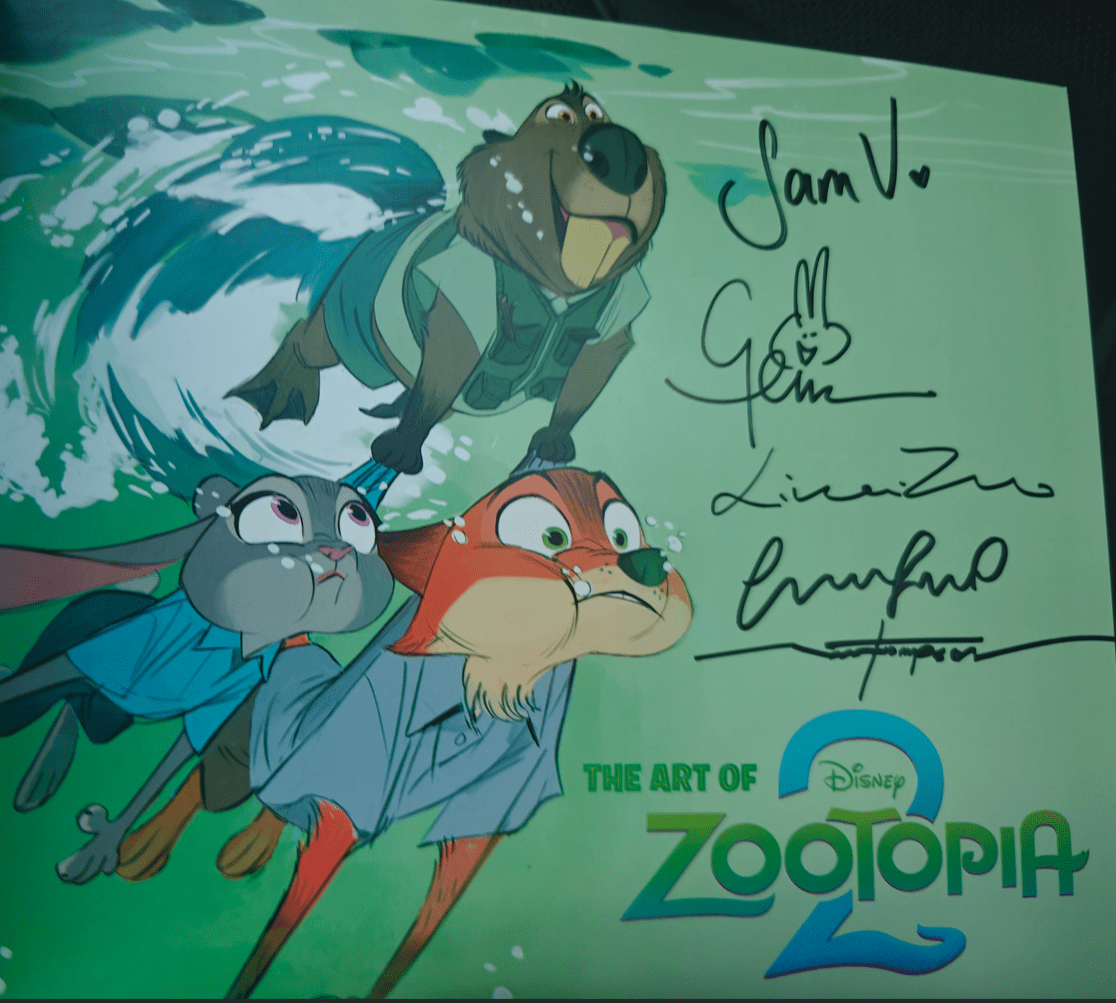
Hello all! I have a special treat for you all, especially if you are interested in the art of Zootopia and the different behind the scenes challanges and stories from the art team. Recenetly, a small panel was held with Carrie Lao, Samantha Vilfort, Leimaei Hshieh, and Griselda Sastruwana-Limei. The presentation itself was filled with art, some of which is in the ‘Art of Zootopia 2’ book, and some of which was original art that wasnt shown anywhere else. I tried to include as much as I could find in the article, but some of it was only shown in their presentation. These four talanted artists took us through different art peices, talking about challanges they faced, aspects they enjoyed, and the overall story of how Zootopia 2 came from storyboard to screen. Keep an eye out as I also had the oppertunity to have a one on one intervirew with Carrie and Gris after the panel!
Samantha: “Welcome you guys, thanks so much for coming. Oh my gosh! Well, we love this, and we’re so excited to come talk to you about our little cool TV days. Yeah, just a little movie — it’s amazing. You guys want to introduce yourself and your job on this film?”
Carrie: “I guess I’ll start for you. My name is Carrie Lao, head of story on Zootopia 2.”
Leimaei: “My name is Leimaei Hshieh, one of the Environmental Art Directors.”
Gris: “Hello friends, my name is Griselda — you can call me Gris. I am the associate production designer for Zootopia.”
Samantha: “And finally, I’m Samantha Vilfort. I was a story artist, so Carrie was my boss for a time. It was a great ride. And to start, let’s jump right in. Do you guys have a kind of favorite piece or moment from Zootopia 2 you’d like to talk about? Because we, I think, already have some Ami art ready to rock for you guys. Gris, you actually brought this piece up.”
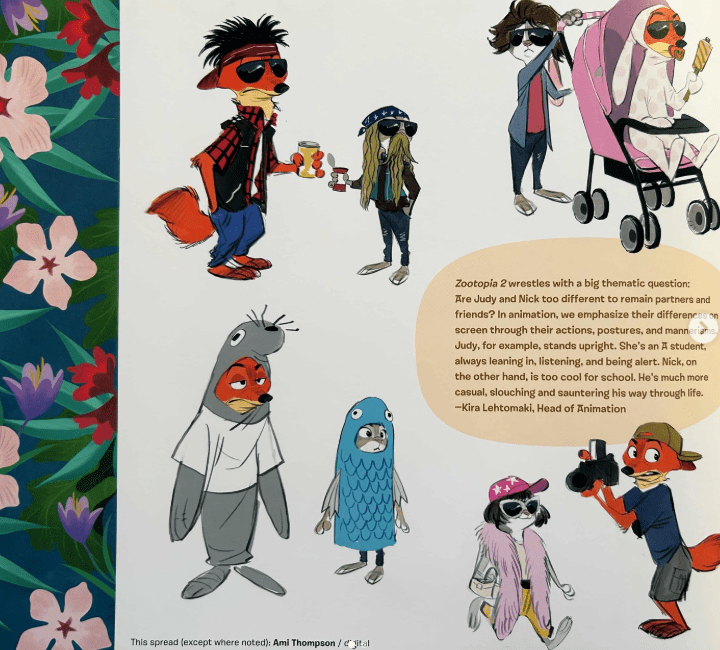
Gris: “Yes, I really love this piece from Ami. Ami’s artwork is great and it’s really, really, really hard to pick which one’s my favorite. But I believe this is the heart and soul of the beginning of the movie, where they’re going to go undercover. And I just love her sense of humor. Who would have thought they were going to be in a mariachi band? (not shown in artbook) Any of this is not on the script. This is just something that Carrie tells Ami, like, ‘Hey, they’re going to be undercover, people are going to be funny, do whatever.’ And she just goes all out.”
Samantha: “Because, I mean, these are amazing — and then I think also there’s a kind of thought about our process where everything is figured out and we just execute, but really there’s a really collaborative back and forth. Including in art pieces, you may not see in the art book. Some of it, which Carrie kind of supervised, is this artist named Alvin Ostergaard.”
Carrie: “Yeah, it was really lovely. I knew one of the things we wanted to talk about was our favorite pieces, and this is a piece that, like, I just… I don’t know if you see it anywhere else, but it was kind of made early in the process. We have something early in the process of making a movie where we kind of want to show artwork to marketers and other divisions, so we want pieces that encapsulate what we’re about. Very early on, the meaning of this might be a story where Nick and Judy have to go on the run. So obviously, this scene doesn’t exist in the movie. This is one of the early images — like we showed before — kind of like someone is moving. And he’s amazing — so good.”
Samantha: “And at Disney, collaboration is kind of always top of mind. And sometimes the directors are like, in their brain, they kind of ask the artist to take lead on a character completely. So Jared Bush, our director, is also the writer. And with the script, he was like, ‘Okay, I need to go to the brains of the operation.’ And you guys were a big part of this process, but discovering different worlds — that was a big thing. We had an earlier idea about the burning mammal.”
Leimaei: “This is one of my favorite moments in the film. I really liked it because I think it’s the best representation of the film. I think it really approached the humor and also the ridiculousness of the movie.”
Samantha: “I mean, as story artists, when we saw this, we were like, ‘This is going to be so much fun. This is going to be super hot.’ And sometimes we would help the artist to invent. The directors would bring us ideas about personality, about type of animal — so you guys can talk about a little bit of discovery.”
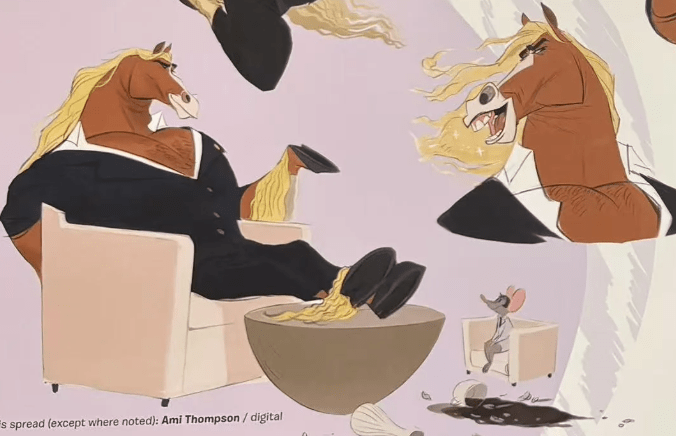
Carrie: “From the story side, I think very early on we actually did have a different mayor character, and there were a lot of scenes focused around this character and kind of dealing with the larger world. Then we found that the character, as the story evolved, no longer worked. So then it became: who is the new mayor? I just remember Ami did a whole bunch of options where somebody did the artwork — potentially a kangaroo or a giraffe. If anyone went to D23 and got an early print from this movie, there was a giraffe character with glasses on the print. And that was when we were like, ‘Is the giraffe in there?’ So that’s kind of a go-to process for figuring it out. But I just remember when she showed these images, I was like… I love this guy. He’s so funny. I like this image in particular — I love it because it’s like him on a talk show and he basically just kicked over whatever’s on the table. And then the little mouse was just like, ‘Yay!’ So even though it was, I think, a bit of a debate — because they were like, ‘Wait, he’s a new character. He has a lot of hair, which you all know is tough to work with’ — but I was like, please let him stay because I love it.”
Gris: “It’s one of those things. Sometimes you see things written down, and then you give it to an artist, and they come up with something — and sometimes everybody knows who the character is. It’s like, once we saw Ami’s new design, we were all just like, ‘That’s him.’ There’s always the technical part, but you know: if the character’s right, the character’s right.”
Samantha: “And they make it — we make it work, right. Oh, I love it. And Gris, you actually did this very early. So some of our scenes don’t have script pages yet.”
Gris: “Yeah… yes and no. There are some storyboards in this because I was looking at a storyboard. I’m talking about collaboration — like we’re always looking at what story we’re doing, and Jared is working so fast.”
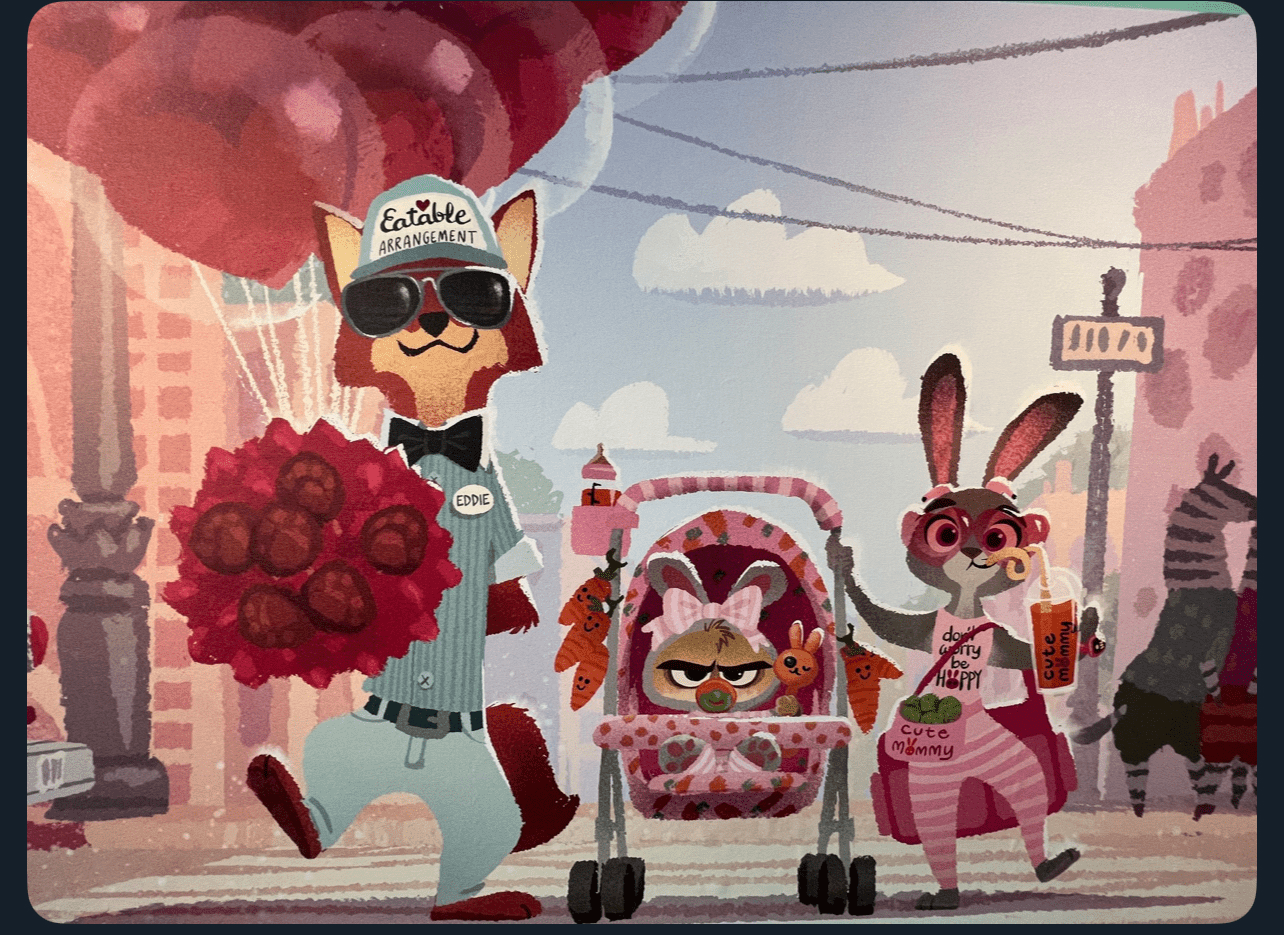
Carrie: “I think it might have been David Mattel because he wanted like the early version of the scene. I remember he was kind of doing the boards and we were like, ‘What is the opening scene going to be like?’ And then we saw this amazing image he did and it felt like it really just encapsulates it — Judy being a mom, funny mom vibe. And Nick originally was like a delivery person, delivering the gifts or something, then became the dad.”
Gris: “And Finnick, we always wanted to humiliate him. Making him extra super duper cute.”
Samantha: “That was the mission. I know, when I look at your little edible arrangements going in there, it’s so charming.”
Gris: “Yes, this one is actually really rare, because this idea comes so early, and this is one of the ones that stuck all the way through. This one’s hanging up in the story room, but…”
Samantha: “Which is super rare. It’s changed all the time. But as we kind of go down the road — as opposed to live action — we do our movies in a series of screenings. So each screening is an album of storyboards. As it gets later, other parts like layout start contributing and stuff, so cinematography becomes a big deal as the kind of rubber hits the road and the grind becomes real for all the hard work. But still, that back and forth never stops. So, for cinematography, to make it feel like Zootopia — to have rules and kind of feelings of, ‘Hey, what is this going to look like?’ Story and art, come on, bring it along.”
Gris: “Yeah, so I would get the script and then the… and then the story breakdown treatment — what do you call that? The breakdown page. Like the outline?”
Carrie: “All the sequences — oh yeah.”
Gris: “And then I like to chart it out — how we want the audience to feel and how the characters feel. And then every screening changed. I always check in with Carrie and David. I’m like, ‘Hey, is this the right emotional feeling?’ And then Carrie’s like, ‘Yeah… no… oh, no…’ I’m like, ‘No? Move it up.’ So that process is really, really fun. And for Zootopia 2, we want the cinematography to feel familiar, but very different. We actually have three different rules. The first one is naturalistic for the familiar area — the location that we go back to from the first movie. The second one is cinematic — so for things that… I’m sure you all watched the movie, right? So there’s no spoiler here. So when they go to the house, it’s kind of dark and creepy. We were really looking at a horror movie. And then the last one is emotional. So things later on — we’ll talk about the weather wall — but the color is based on the emotion of what the character is. So those are the three rules.”
Carrie: “Yeah, it was really great to kind of work with art on this. And we do have our two heads of cinematography, Tyler and Dan. They were really great from the beginning for the entire crew. They had a cinematography presentation where they described: here’s a general rule — naturalistic for the familiar stuff. But then this movie deals with more genre elements — like mystery, horror — the cool blue of a mystery moment, extra dark shadows… and that was really great for informing the direction of the look of the film. And yeah, just working with Gris — once in a while running into her in the hallway and being like, ‘Hey, check out my—’ and she’d be like, ‘At this moment, it needs to be at the right place.’ And I’d be like, ‘Oh, it’s a little less emotional now, so maybe push it up.’ But yeah…”
Gris: “And everyone’s working on top of each other.”
Samantha: “Right, right. It’s not as elegant as it seems in the artwork sometimes. And speaking of emotion, I definitely know I felt something as soon as I read the script and saw that Judy was giving Nick the tux! Thank you, Jared! But, I mean, with the gala, there are many passes — first in story. When we start in story, often we don’t have a stage set. We don’t have… it’s very, very collaborative at this point because we have to keep track of what we’re building together. So Carrie, can you talk a little bit about how this scene started to form — like what we started to learn as we went on?”
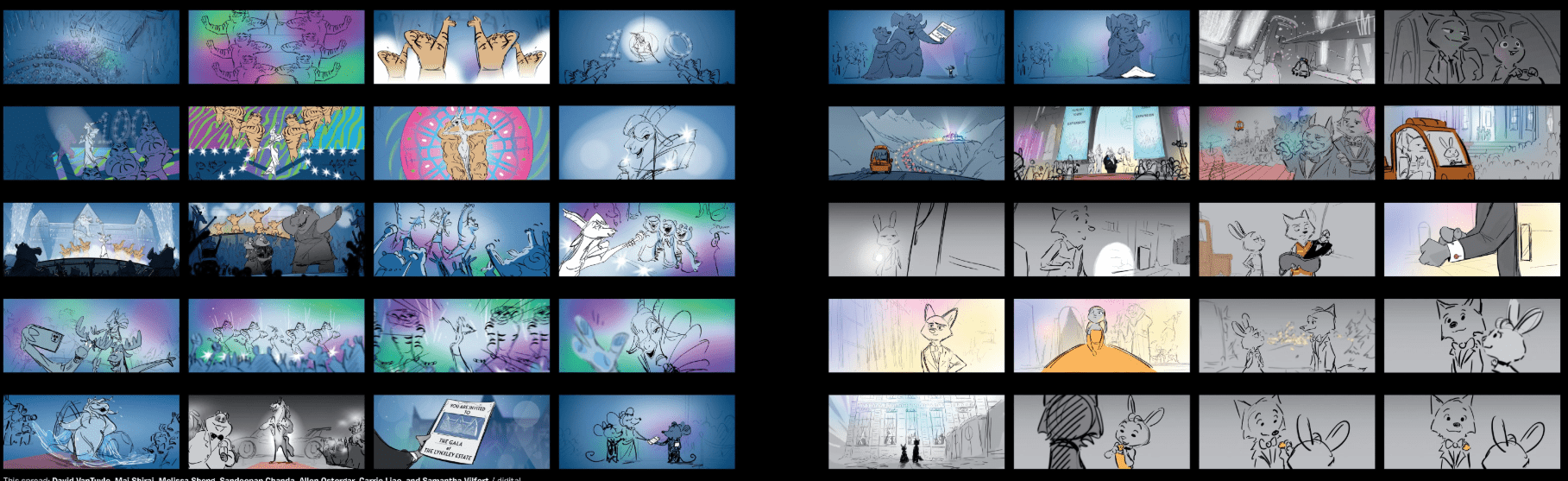
Carrie: “So the gala came early on, but it was early enough that it was not developed into this first version that was shown anywhere else. From early versions of the gala — and you can see, like, top right corner — originally Judy was invited to the gala as opposed to having to sneak in. So there’s more of an element of coming into this grand entrance. And, you know, for a bunny from Bunnyburrow, small town, we wanted to make it feel like a very special experience — like, ‘Oh, now she’s hanging out with this really glacial thing.’ So when we are figuring out the story, we’re still trying to figure out what we need visually. So there was always going to be this kind of VIP area you see in the far top right. The introduction of the Lynxlys. Again, Alan — one of our story artists — he did an amazing job creating this weird cat tower kind of construction where they were sitting high above and stuff. And there was always kind of a stage there. But this is early on when it’s like, we’re still figuring out where do we put all these elements. Once we started working with VizDev and getting some of their designs and more of a sense of what this would be, we would adjust the storyboards to reflect that. There was this sense like, ‘Oh, okay — if the Lynxlys, it’s going to be in Tundra Town somewhere, so it’s going to be more icy.’ So you see, like, ice sculptures, all that stuff — imagine what it could look like with snow falling. And just working with VizDev concurrently — the more they start to design, the more we try to incorporate it into the storyboards. At the bottom you see another piece that Alan did, which is like the interior room — you know, where Gary grabbed Milton — and that was based off of one of Lucy’s paintings, which you’ll see. So we got to… we were like, oh, the stage maybe is more centered to the room instead of, like, to one side. So it’s just showing that as the needs of the story change and as we get more information and design, we’ll adjust the storyboards.”
Leimaei: “So for this one, we actually take different paths at the very beginning. Different artists have a different version. I think Gris will have a version, and my team has another version. But if we go to the next, you can see the final version: we try to get this really beautiful gala and just try to figure out the space and overall architecture and structure. When we showed to the directors, they really liked it, but they also really want to push the location to showcase the Lynx living habitat. So we changed the whole material in this area to condensed ice — because Lynx used to live in cold environments. And also we changed the color to kind of blue and purple so when Judy wears her golden dress, she can pop in this area.”
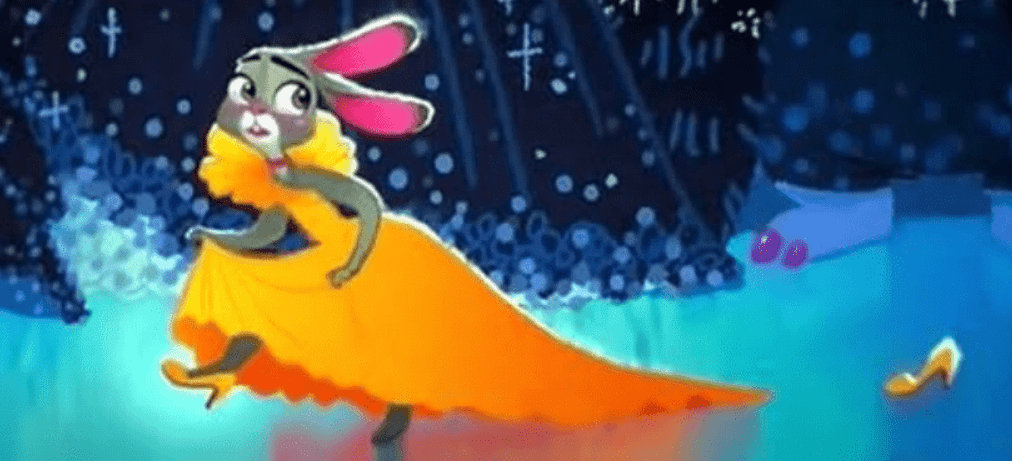
Samantha: “This is a very Griselda special moment. I remember I was given a version of this scene early on, and I think we both were like,’It’s perfect!.’ So yeah — totally: the dress. I’m still obsessed to this day.”
Gris: “We all know there’s going to be a gala, and then we talk about a moment for her to be like a princess. And my favorite movie — one of my favorite Disney classic movies — has always been Cinderella. I always feel like this is going to be her Cinderella moment. Or some version — they were wearing shoes.”
Carrie: “Early on, we were like, ‘Yes.’ Because there was a story element of Judy feeling a little uncomfortable — it’s like a nice dress — but then we’re like, wait, they don’t wear shoes. So she’s with the gala, and we’re like: do we want to model that many shoes? And so yeah — but this was my chance to give Judy a Cinderella moment.”
Gris: “Corey has always talked about the environment of the gala party to look like the Frozen 2 wrap party. That is the cyan and the magentas — and those are Frozen 2 wrap party. Yellow — we don’t… yellow… there’s no yellow in Frozen. So I thought one of the reasons is because it all… too much attention, but it’s perfect for this moment because we want to give that much attention to Judy, and also the volume — because she’s so little, the volume will help us spot Judy. And I also see a lot of storyboards — we all think at the same time with like, uh: make her dress big and goofy and pretty. And a funny story that I shared: production was like, ‘No, that’s going to be too complicated.’ They keep making the dress, you know, less poofy. And then the story artists make it more poofy. But Sam always put it like… I don’t know, like Marie Antoinette.”
Samantha: “It’s insane. I was like, I love it. I also thought, like, as a story artist: this is a character that kind of is trying to be bigger in a world of these huge animals. I knew she was going to walk through this big ballroom filled with rhinos — the little cop was going to try to feel like she can stand up to them. So I was like, ‘Bigger is better.'”
Gris: “Yeah — to give her a visual volume, and production says no, and the story artist said, ‘Yes!’ And Jared got used to the big dress. So when he saw the little one, he was like, ‘What happened?’ It’s small now?.”
Carrie: “There’s that thing where you push it further, because then when they give the note, they reduce it down a little. And you’re like, ‘That’s actually perfect.'”
Samantha: “These things cost money — that’s why. There’s a price tag on the dress and it’s very big.”
Carrie: “Here’s the room that we saw — this painting Gris did — and then our artist kind of designed the room around it.”
Gris: “I was looking at his board in order to create this painting. I was looking because Alan always put the Lynxlys— Alan and Will — they always put like… as if they’re cats. And they put like a lot of cat condo stuff, you know, on their board. And so I’m like, okay, that is brilliant, even though the Lynxlys are bad. But at the end of the day, you’re just kitties.”
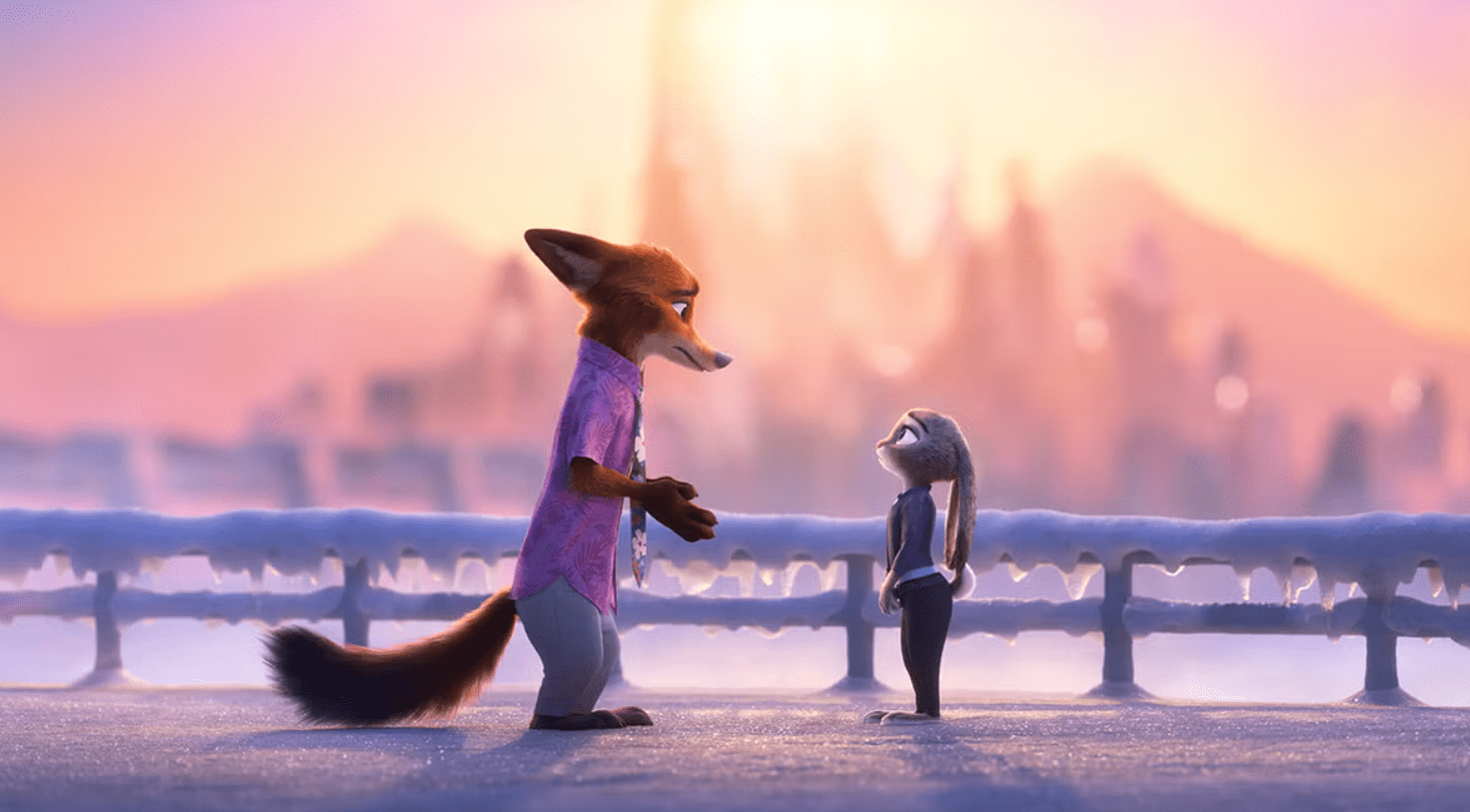
Samantha: “We can also move on to our next part. With Nick and Judy standing outside the Gala in the snow..”
Gris: “So for this one, we… this is the one where there’s like: we need a moment where it feels like a Christmas card — really, really warm and inviting — and they’re excited to be there. And there’s a little bit of romanticism…I uh, I mean not between them… I mean towards the case!
Samantha: “I mean—” Laughs and shrugs
Gris: “No,but more like: they are so excited about going through this amazing gala from the outside. And they look good, and they are on the case.”
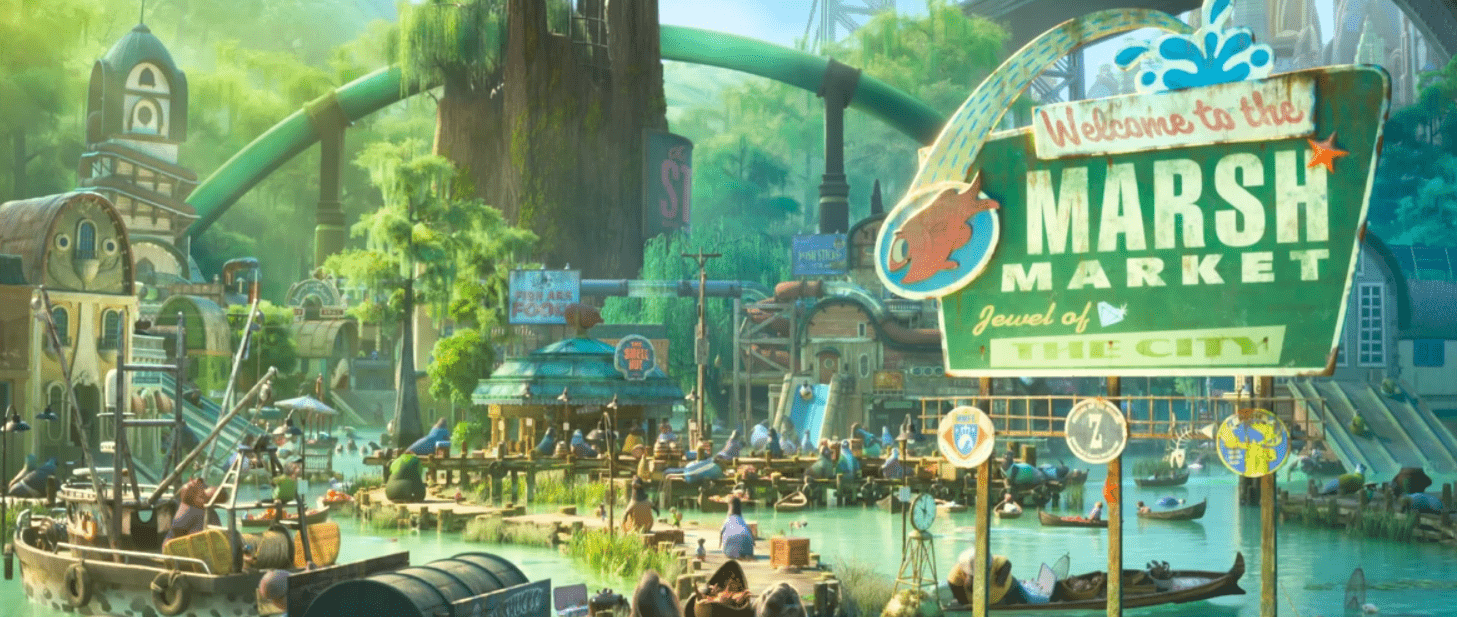
Samantha: “I mean, you want them to go party. Come on. I mean, the dream. And which brings us to: it’s not all glittering outfits in this movie. When they’re on the run, they have to go to another beautiful and complex set, Marsh Market, that has to have a huge chase in it — which means it’s huge. So we made a lot of beautiful work in this area just to bring it to life.”
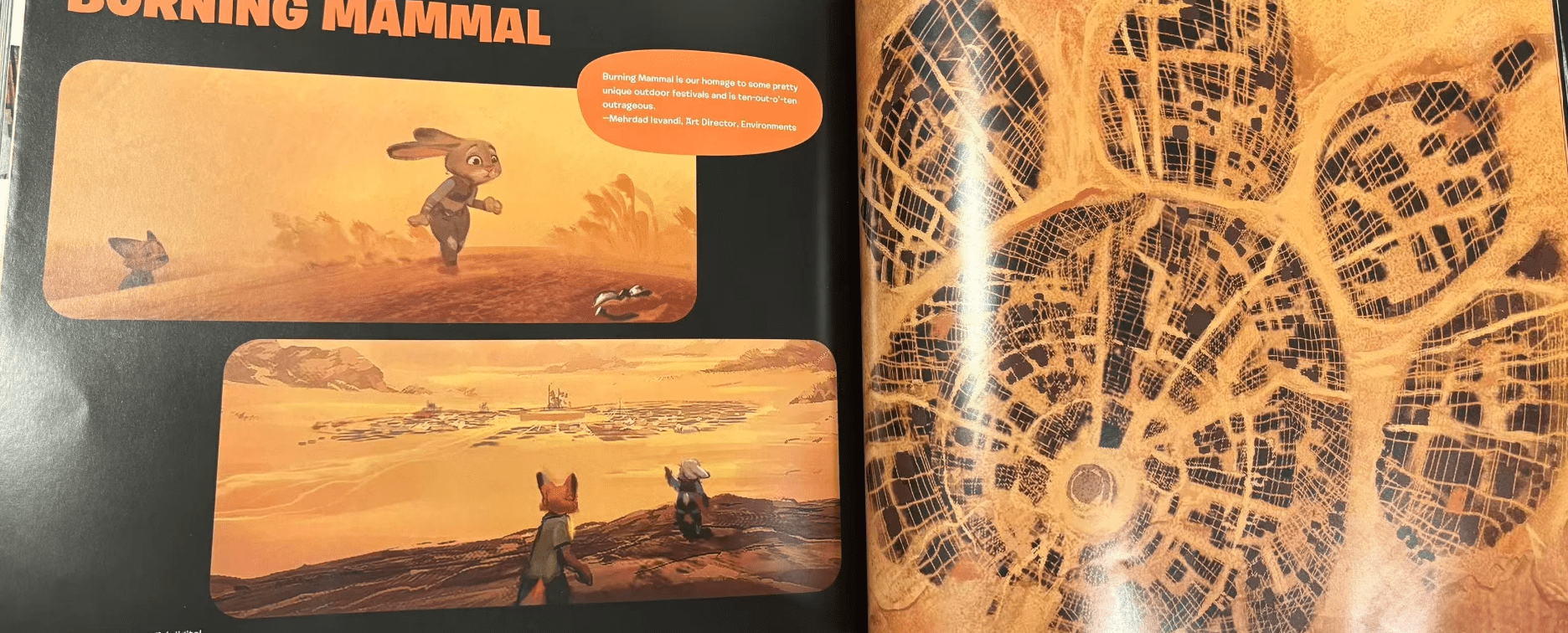
Leimaei: “I think this is definitely one of the most challenging areas. I think when we started on this location, we already knew the story wanted a chasing moment in this area. And the directors want this place to feel chaotic, fun, and a little bit awkward for the community. So after Corey had this idea, he created some visual guides for us. For example: the animals in Zootopia are not serious adults, so everything they build should be really playful and full of personality — nothing too sharp or too clean. So we were thinking, oh, maybe we can make this place more like a water park. Another thing: this place should reflect animal living. So we create a lot of pipes, elevators, and slides so the animals like seals and sea lions can move around here very easily — don’t really have legs. And here’s an example that I call a map for the plan of the chasing moment. You probably can see the entire place almost built by blocks or cubes. This is one of our strategies. You can go to the next one — you can see each cube what it looks like. So we build a bunch of those and use them like modular pieces. And because each cube has a different [look], we can mix-match them to create different types of street. Yeah, and the modularity was super useful.”
Carrie: “Because actually, the Marsh Market was from the beginning one of the environments that Jared was absolutely sure of. He was like, ‘We have to have this in the movie. We’re making it even if we don’t know exactly how the chase is going to go.’ And if anyone remembers, I think that was one of the first pieces released at D23 — was a Marsh Market piece. And so that was very early on, and us seeing these designs was very helpful with the modularity, because it’s like: we’re building something so early on, even though story-wise we don’t know exactly how we’re going to utilize it later fully in the film. But they were able to construct a kind of illusion of a walk-through world that felt very real.”
Samantha: “And then later for the film — last section — but obviously everything comes to a head in the weather… oh my god. Emotions, fear, drama. And I know this was big — it had to go through the gamut — and this emotional scene had to happen here, which was a big collaboration between everything we’ve been talking about: strategy and emotional color, emotional filmmaking. So, okay — can you tell us a little bit about that?”
Carrie: “Let me talk about this one first. So the weather wall has always kind of been a feature in this movie early on. And then, on the bottom row, you’ll see kind of… like drawings where you can see it’s like Nick pulling up Judy from the weather or something — but those are early versions before the weather wall appeared more in the middle of the film. Actually, after the Marsh Market portion, where they were pursuing someone, and then maybe Judy got into a pickle and had to be saved. As the story developed closer to what it became, we were like: okay, this feels like more of a climactic moment — for Nick and Judy to go through this low of being terrified for each other, worried about each other’s safety — and having to navigate this unique environment where you have hot on one side, cold on one side, creating really fun and unique lighting choices. And as we kept developing, it was really helpful again to collaborate with VizDev — some of the panels there which David did — you can actually see we took the actual VizDev art and put it into the storyboards, just because they did such an amazing job of visualizing the space. And we were kind of like, ‘Why did we have to draw all these stairs?’ So again, it was really helpful as a process to figure out the space working with VizDev.”
Samantha: “Yes.”
Gris: “And speaking of emotional moments for color: if you plot out the movie realistically, you think about Nick and Judy in the… in the prison. Right? And then basically, this all should happen at night. Of hope, reconciliation, and you know — this is the moment after they’re so vulnerable they just want to embrace each other. So the sunrise becomes very important, and that’s why.”
Samantha: “Oh — and obviously, when you’re watching it, you’re just caught up in the feelings, and you don’t think about the math Gris had to make of like: what hour is it? What time is it? Because color is so emotional — it will hit the emotion over and over.”
Carrie: “Yeah, do you mind going back to it first? So this is to reflect kind of what Gris was saying — where originally, when we boarded this, obviously Byron took a crack at it and made it amazing. But again, Alan helped out recording the first version of this moment. You can see in there that, yes, at the time we were like: it’s happening at night, which is why everything’s toned a certain way. I think it’s funny that Gris mentioned that, because a lot of times the crew, we were like, ‘Oh yeah, this is definitely going to happen at this time.’ And Jared or Byron were just like, ‘Nope.’ Daylight version. I kind of had to adjust to that. But funny story: Alan Ford had a first version of this, and then of course Byron Howard — one of the directors — went in and refined the expressions. Thank you to all of the story artists in the studio. Alan was no exception. And then we were telling Alan that when Byron got to that last panel over there — the bottom right one — Byron was like, ‘This expression is just so good. I can’t redraw. I can’t touch it.’ And Alan was like, ‘No, that’s like my first version. It’s so ugly.'”
Samantha: Alright! Well taht concludes the part where we talk. Do you guys have any questions?”
Audience: “Do you have a favorite character old or new?”
Carrie: “Out of the new cast, I have a soft spot for Windancer.”
Samantha: “I’m still a Judy girl, but… yeah!
Audience: “In animation, I feel like development and pre-production kind of never stop happening. Can you talk a little bit about what that looks like?”
Carrie: “I think one fact Byron likes to talk about is there is a scene with like 30,000 or 40,000 characters in it or something. So there’s a lot that goes into it. Normally in a pipeline, it feels like: okay, story, and then one department passes to the other. On this one, everything was just on top of each other. And I think that was why it was really important for this show. Jared and Byron really championed collaboration between the departments,, so there is a lot of departmental collaboration — which was wonderful. This is my first time being in this role and I’ve never gotten the chance to interact with, like, the heads of animation, the production designer, supervisors, so much. They were super helpful because it was a necessity — as animators are animating things, if things are changing, we have to communicate that down the line. We have to adjust the story quickly so they know: here are the designs you’re actually going to use. So it does happen, especially in this movie, and they really fostered this culture of collaboration that made it a really great working experience.”
Audience: “I’m a big fan of how reptiles are in this movie. I’ve been obsessed over how you were able to take the cuteness of the mammals and translate it over to reptiles. With that in mind — because you were working with the stereotype that reptiles are scary — was it difficult for the artistic team to translate reptiles and make them look more fitting and more cute, for example Gary?
Gris: “I wish Ami was here to answer that. Ami and Meg — they’re just masters of making anything appealing. They can make a rock look cute.”
Carrie: “I tell you what — it can be an issue.”
Leimaei: “I just realized something after I watched the movie — and Gris reminded me — that when we see Gary, his tongue: sometimes we use a human tongue, because a snake’s tongue can be a little bit aggressive. But sometimes you will notice a normal snake tongue.”
Carrie: “Yes — that was one of the things one of the heads of animation was talking about. In Zootopia, we try to keep animals true to life. But with the reptile — with Gary in particular — he doesn’t have eyelids, so he doesn’t blink. That’s true to life, but then sometimes he has a dual tongue, and that’s really for communication. When he talks, his expressions — you might notice sometimes there’s teeth, extra teeth, and stuff. And again, it’s just adjustments we need to create appeal and a little more human relatability.”
Gris: “Sometimes he has teeth, and sometimes he doesn’t.”
Samantha: “Yeah — and from a board artist perspective, real quick: so much of the charm also was found in the boards, in how he moves — not making him monstrous. I think we won over the audience with the body language as well. I think it was our priority. Yeah, he’s really cute.”
Audience: “Hi. I was just wondering: was there any ideas for the first movie that could [have been] developed / brought into this?”
Carrie: “Oh my gosh — I think actually there were.”
Samantha: “I remember early on, Jared and Byron’s original version of Zootopia was a little bit more spy — pushing more spy tropes and elements, more James Bond.”
Carrie: “Yeah — and I think there was a lot of pulling from what they had created for the first film already. I don’t remember anything in particular, but I know it was a discussion.”
Gris: “When the movie started, I believe there was a version where it started like three years after the first movie, and then it became like a week after. Right? So if you watch — their iPhones are the older version of the iPhone. And they have earplugs that have cables. That was a conscious decision. It was not a mistake.”
Carrie: “But I think we do try to take good ideas from the first. And also from our other movies — because I think the Marsh Market might have started from Moana. You’re like: where can you find a dolphin?”
Leimaei: “Oh, some of the Marsh Market architecture is from Moanat.”
Audience: “So I’ve watched Zootopia 2 like 11 times. My question is: what is your favorite scene that you got to work on?”
Samantha: “A lot of people here kind of worked on them all. I would say the gala. I had such a good time. I was like, ‘Jared — please can I have the gala.’ I needed that.”
Carrie: “We were like: ‘Let Sam cook.'”
Samantha: “I think I drew it a little bit too romance-y. I think Carrie was like, ‘You gotta go back.'”
Gris: “I like the gala because I love dresses. I’m like in cloud nine when I’m like, ‘Judy’s going to wear a dress!’ Yeah!”
Leimaei: “I would say Marsh Market is just a really cool, up-to-date place to work on.”
Carrie: “And I’m just working on certain scenes because all of our amazing story artists did such a great job. But one of the ones was the reveal of Pawbert and what he has as his gadget and stuff. So that was a lot of fun because there was an earlier version where he was a lot more hammy — kind of mustache-twirly — and that was a fun early version to do.”
Audience: “My question is: with all of these new characters and their personalities, what is the collaboration you guys have with the art department to make their designs fit their personalities?”
Samantha: “Well, sometimes that changes on top of itself. I know Nibbles was a big question for a long time. Because there were versions of Nibbles where she was a rookie cop, there were versions where she was just kind of like a reporter chasing after them — and we were like, ‘Oh, that doesn’t happen.'”
Carrie: “It was Sam and another one of our artists, Hannah, who were like, ‘What if she’s like a YouTuber or a podcaster?'”
Samantha: “She needs to be a little bit more edgy. Who has a reporter vibe that’s a little bit more edgy? Because our directors were like, ‘This version isn’t working,’ and we have to control so much — we’re at a kind of loss. So when that happened, that also gets to inform. When the directors buy off, they’re like, ‘Oh, cool’ — then that informs R&D and can take it to the next level. But we already had a design of hers that Corey had done that was beautiful.”
Gris: “I love the… such a wonderful, wonderful job putting in all the gestures and making them look very friendly. The movement is great because they all have their distinctive speed — the way they move, depending on what type of animal they are. Nibbles always seems kind of nervous you know? It’s just so adorable.”
Carrie: “Yeah. The ideas for the characters can really come from everywhere — anywhere — which is why collaboration is so important. For Gary in particular, the supervisor had us looking at a test you guys have seen — Gary in one of his old talk show interviews — and that was before Key was cast. And we felt like: oh, that was such a Gary thing. And then one of our story artists, Tom Caulfield, got an early version of the sequence where you introduce Gary, and he did the first version of Gary where it’s just him doing really fun shapes with his body and being quirky. And instantly people were like, ‘Oh yes — quirky, sweet Gary.’ That felt fitting and also like a good emotional core for the movie. So really — from everywhere — and there’s a whole bunch of characters…”
Audience: “How is the development of the Ai changing anything?”
Carrie: “Well, I think that our… you know, we have a history and legacy of artists and championing what artists do. So I think that regardless of how Ai has to be implemented, everything should be with an artist’s hand. It should be a tool, like anything. And I think that everything in Zootopia 2 has an artist’s touch in it. And I think that’s what the studio’s really supportive of — is artists making art.”
Audience: “So in regards to Gary being a pit viper — was there a reason he was a pit viper versus a constrictor?”
Samantha: “Oh, actually, randomly, I can speak to that. I was with Jared very early on in development, and he was like, ‘I need you to go research snakes,’ which is one of our great jobs as artists — to present a charcuterie board of options. And one thing I brought to him — nerding out on snakes — was: pit vipers have that kind of sixth sense of heat sensing. It’s not just heat vision — it’s like knowing where prey is even in pitch black, and that comes from the pit organ, which is different from other snakes. And I also gave him this drawing of different versions of venom — like, ‘All snakes have different venom; they’re like bartenders with different cocktails.’ And he was like, ‘That sounds kind of scary.’ So I think it was just getting the director research and having them see scenes in their head — like, ‘Oh hey, I can do more with that kind of snake to create drama or tension.’ And I think they were really attracted to that.”
Audience: “Hi — so one of the things I love about Disney movies is there’s always little Easter eggs put in here and there. One of the Easter eggs I didn’t notice toward the end of the movie was the Stray Kids fan that was in the audience. So having gotten into production, how did the implementation of the Stray Kids light stick come about toward the end of the movie?”
Carrie: “Oh, I think that very early on in the movie there’s a lot of potential — collaboration, other brands and products. Especially for the world of Zootopia, which so many people gravitate towards: it’s a rich world with fun potential. I believe it was like: okay, there’s a Stray Kids collaboration — where is the most fitting area to put it where it feels natural? The ending scene felt like a really great spot for that — like a fun party environment for the credits. And K-pop fans love seeing that kind of thing, so it felt like the place for it.”
Audience: “First of all, I love you guys. It’s great to see you again… I really support Jared and that environment. One thing I’m really excited to talk about that hasn’t been mentioned much is the inclusion of Outback Island. Can you talk about how you guys integrated Robert Erwin’s’ hair into the koala and what it was like working with him, and creating the scene with Judy and Nick catching Dawn”
Samantha: “I think Jared and Byron are also like… Jared is a guy that has so many versions in his head. I think each version that doesn’t make it into the movie is fodder for something in the future. There’s a version we don’t even know about where Zootopia is like 20 times bigger — only he knows. There are fun little peeks into that. We’re all animal enthusiasts, so getting a koala in there — can we get a koala, can we get this animal? We have a limited budget, but we try to expand a little more every time. So I think that’s a fun challenge: how much more can we expand?”
Gris: “Making the four-thumb claw was a weird something. Because it was made with just one regular koala, and then they actually… we put two other koalas for the [thumb]? And then we like shrink it or hide it. I don’t know what they did — but it was a big deal to have the four thumbs.
Audience: “I love the sequel, and I’m sure as you all know, making a sequel is probably very difficult. But I’m curious — having an existing movie, did that help enhance your creative process, or were there parts of it that made it trickier?”
Gris: “Visually, it was definitely a challenge. People are always like, ‘Ah, it’s easy — everything has been done before.’ Well, in reality, there are two things. First, our technology is always advancing. So whatever we design in the first movie has to be redone for the second movie with different technology. And second, you always want to outdo the first one, but make it feel familiar at the same time. So I think the environment team did a great job of having the same feeling and the same rules. And for cinematography — point of view — that’s why we have three different lighting qualities: one familiar and two new”
Leimaei: “The first movie is fantastic — that helped us a lot — but we want to expand that into the second movie. So I try to account for how many new areas we have in the second one.”
Samantha: “Just real quick from a story perspective: when you’re storyboarding and trying to stay true to the character, you might have a version of Nick or Judy in your head — what would they do, what would their acting be? Always trying to keep it consistent. Even in the drawing — like, whenever you draw Nick, you’re drawing his eyes half-lidded. When you don’t, it’s a big deal because it means something — an expression. For Judy too, that’s a whole other emotion.”
Audience: “First of all: there’s a ridiculous amount of collaboration and work between people that makes this all come together. But when you’re going to see the final product, what is the one thing you look at that you go, ‘That’s me, no one else’? And on top of that, which one of those is your favorite, and what do you look for when you watch it?”
Carrie: “Oh, my gosh. There are times where you work on something really hard and it doesn’t make it into the final. And that’s only a little bit [sad], because you’ll be like, ‘I worked on this,’ and your family will be like, ‘Which part?’ And you’re like… For this one, I feel really happy. I feel like we really tried to have something from every story artist in the movie — so people can point and be like, ‘I did that one.’ For me, I touched the Pawbert reveal scene and everything. So it’s nice that people can see: there’s a moment in there that was mine. And I understand you contributed so much to the gala.”
Samantha: “Oh yeah. I did a lot of the boards for when Judy first meets Pawbert, and they stayed for a long time — so some of that blocking is still the same. And I’m really proud of it. But also I’m like: oh, it looks good — it’s working. That’s what it’s like.”
Leimaei: “For me, probably the Marsh Market design. When I designed it, I was like, ‘Okay, I hope this works.’ And when I see the final lighting and texture and 3D, I was like, ‘Wow — this is really beautiful.’ And 3D did an awesome job making it come to life.”
Gris: “For me… it’s the whole movie. I usually focus on costume design, but in this movie I went back to environmental design, and Corey was like, ‘I don’t want you to do any costumes.’ But I was funny, and I did the costume anyway. But then Meg and Corey… including the title and then the credit. And I get to see it frame by frame — like eight times — for the different color timings. And every single time I see every frame, my mind is blown. And I’m like: is this the most beautiful movie or what?”